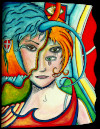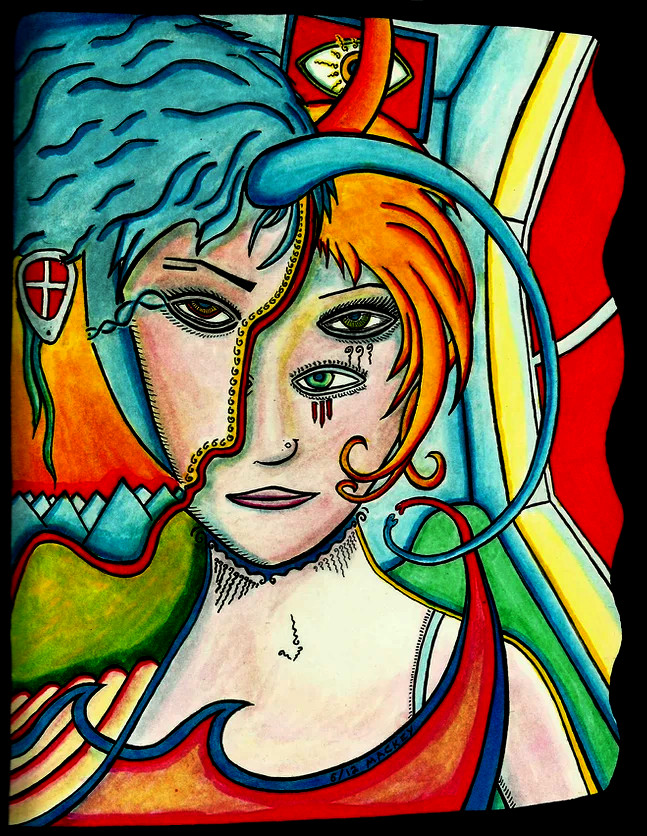
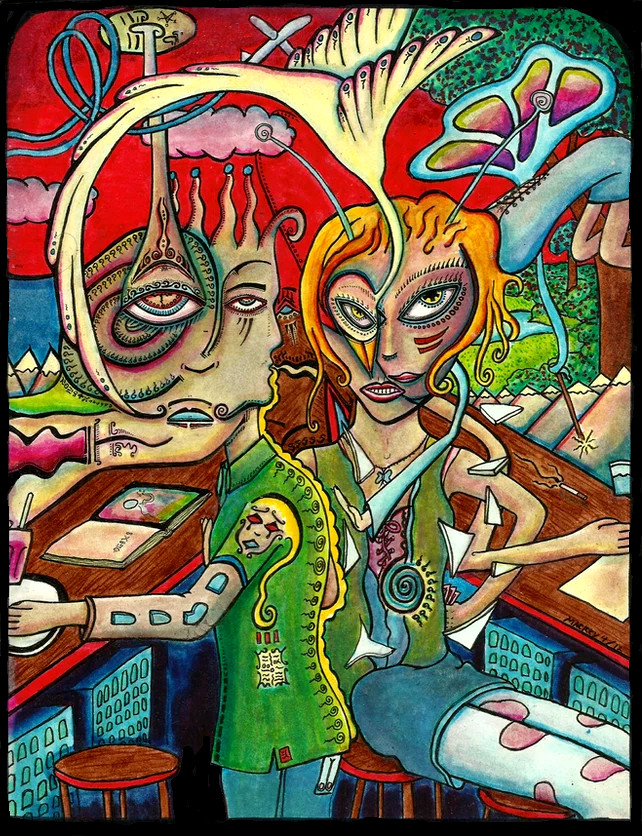
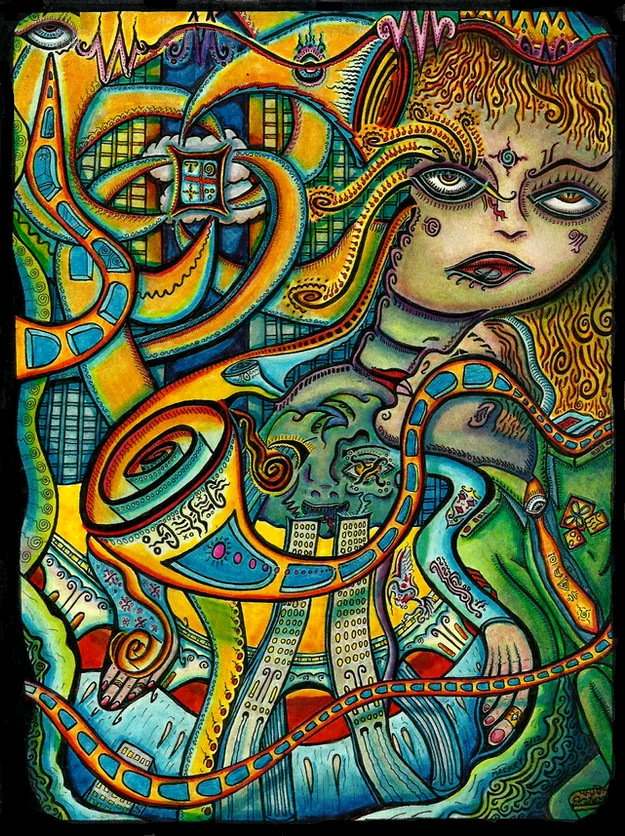
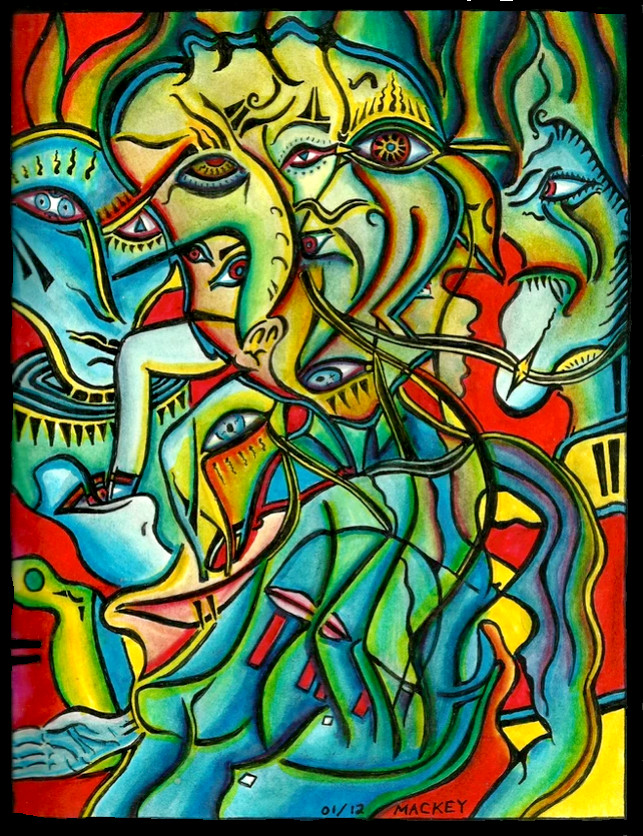
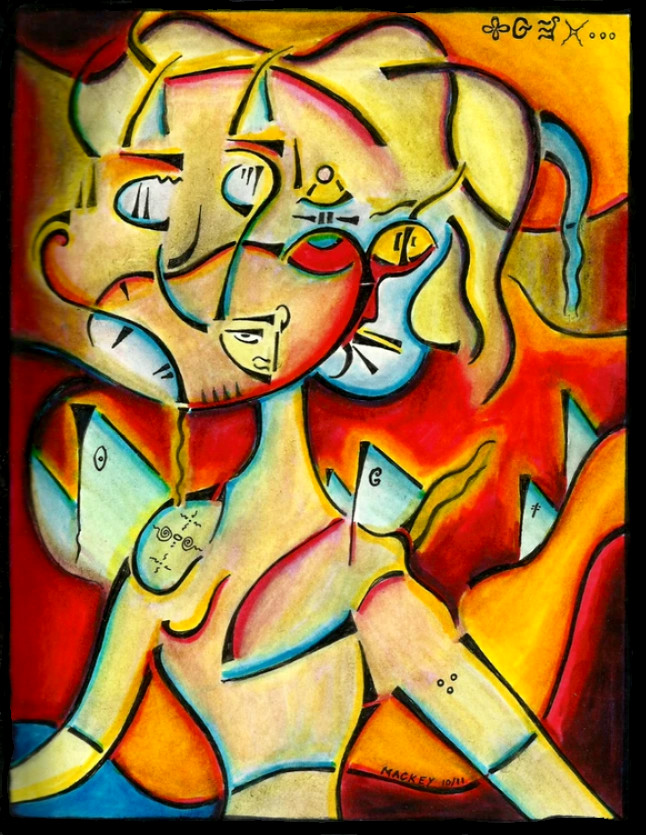
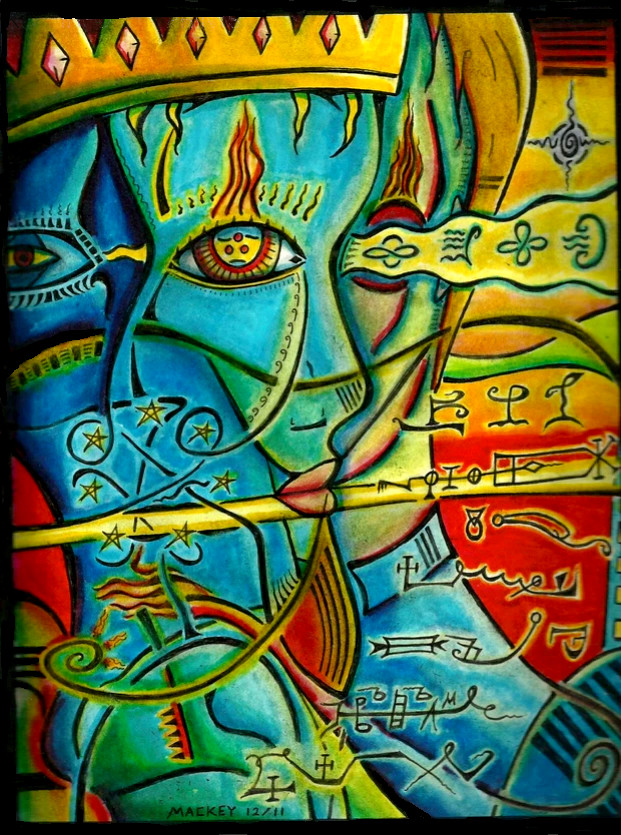
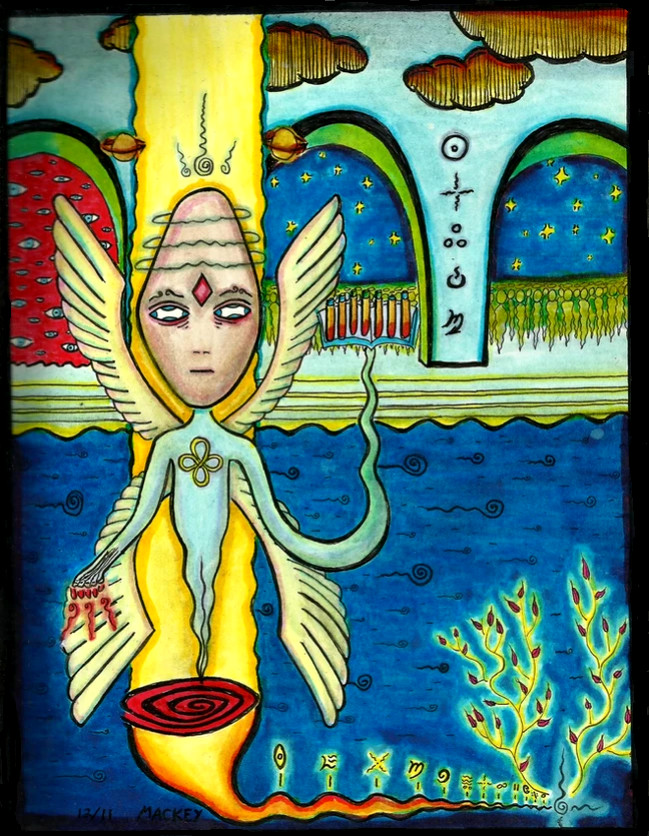
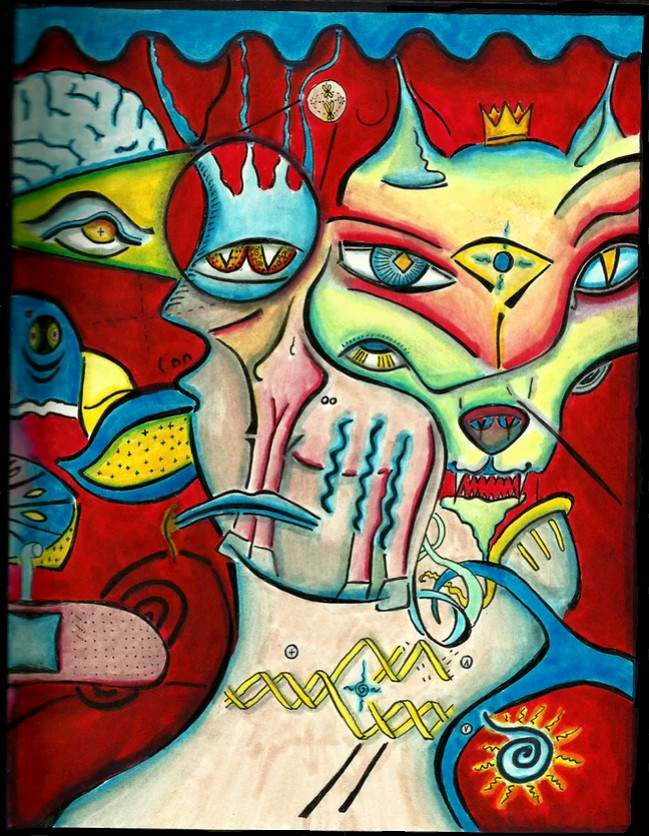
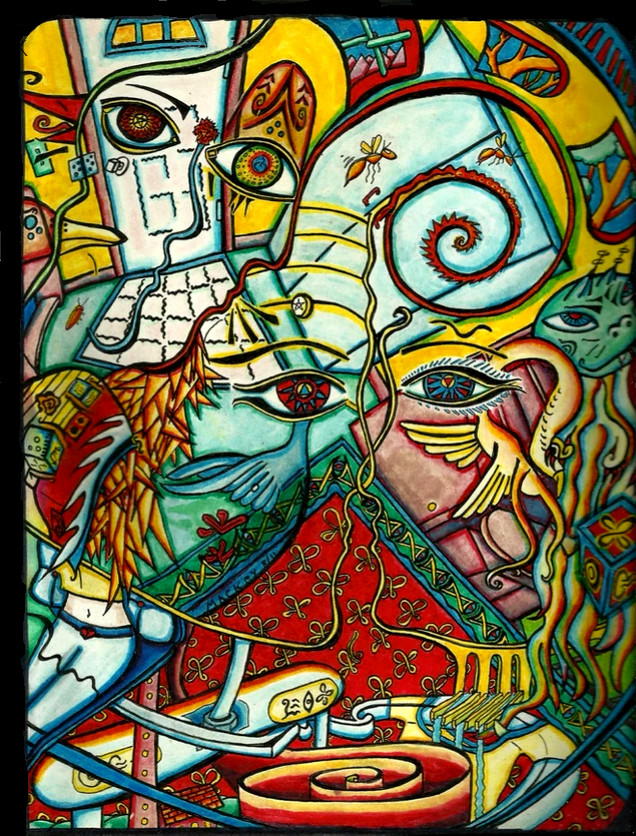
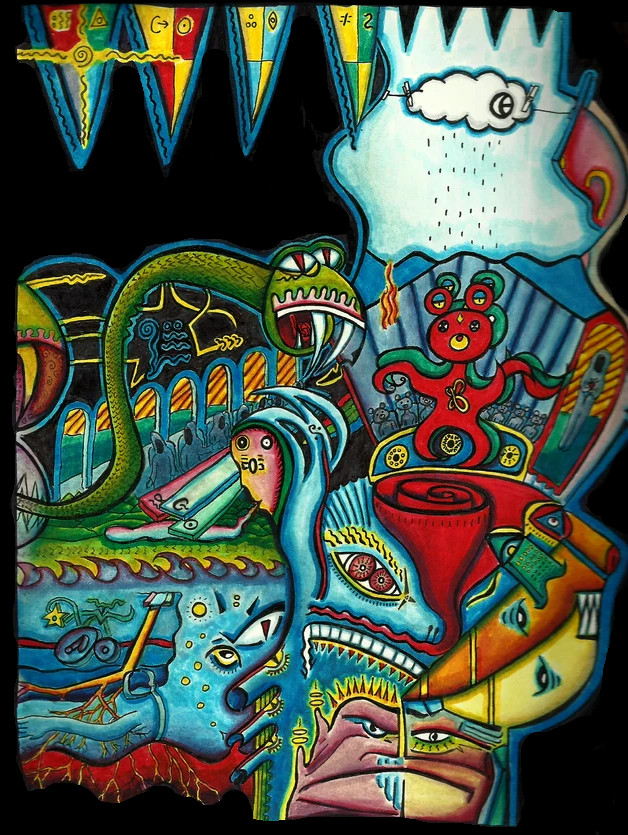
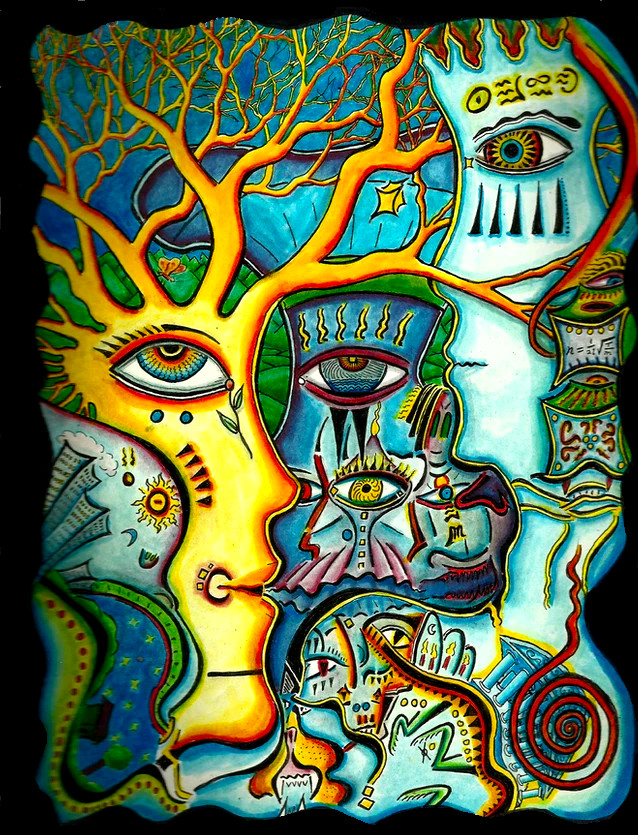
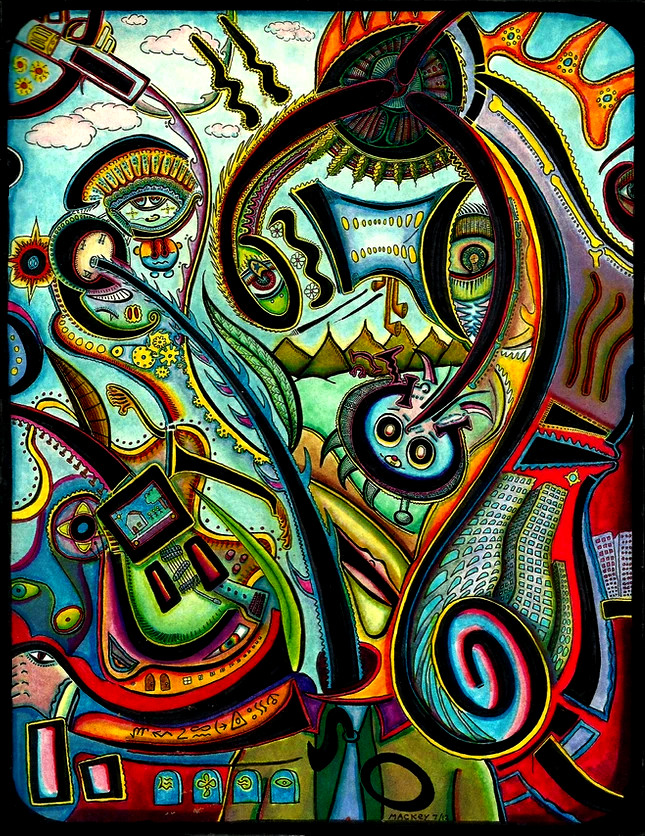
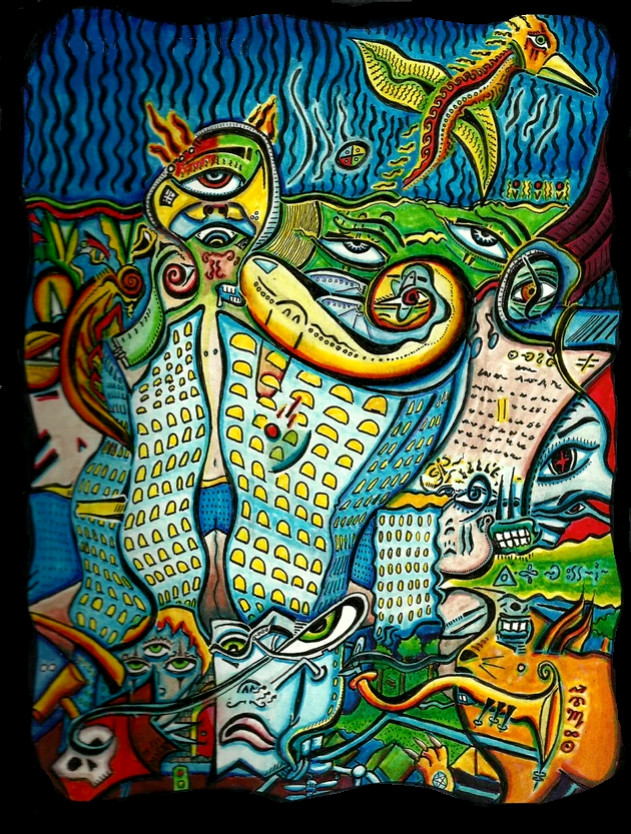
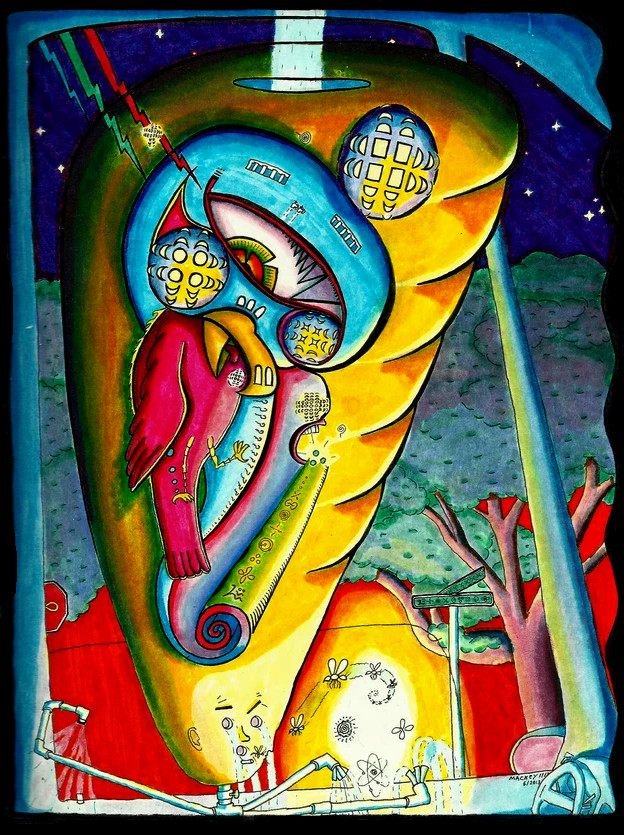
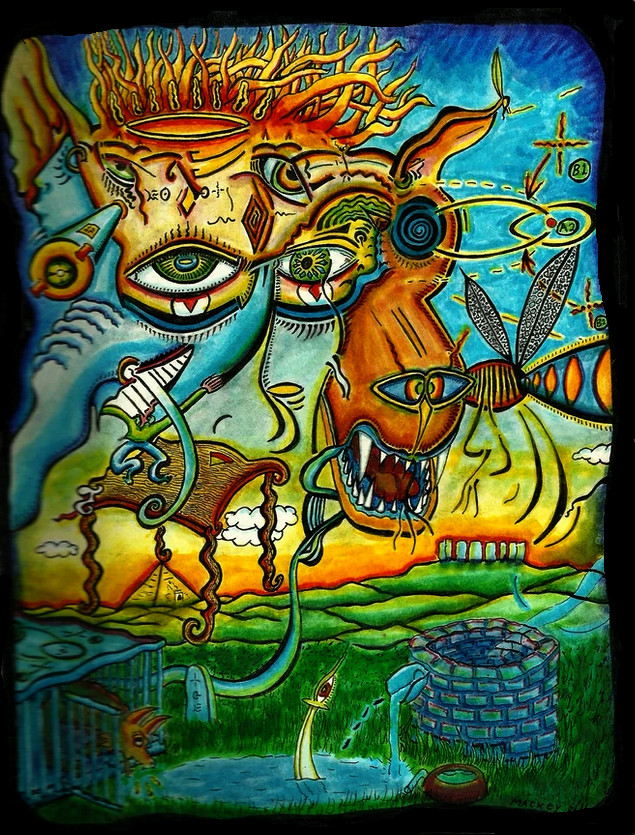
All the pictures in this gallery are 8.5x11 inches. They are pen and watercolor on paper. The richness in color is from watercolor layering using Tombo watercolor pens.
I've been doing this style art for over 10 years. I first started with small doodles that slowly grew in size till I was doing 10 feet murals. Then I settled to a smaller more portable size so that I can have a faster and more effective dialog with my unconscious. I'm interested in producing lithographs of my work along with a book called "The Book of Hours" which will include my art and poetry.
I've had my reservations ethically on becoming an artist and it took some soul searching to understand why that is. I think the philosopher Plato can express the probelms that I've had in intending to create art for the public.
Plato objects to art ontologically - as in the experience of it - because he sees art in the realm of images as opposed to physical objects; hence, it has the lowest ontological status because images are just copies of copies of copies. He also has a moral objection in that art appeals not to the intellect - as does philosophy - but to the passions, which it stirs up an already chaotic public. Therefore, art can be dangerous.
I will not disagree with his objections; these are common qualities that art does possess. But, I implore you that art can possess virtue and insight not only for personal development and growth but also for intellectual insight; to cultivate the progress of man as a species and to plumb the depths of one's unconscious - that's looking back at you and learning along with you.
Aristotle would say the function of art is memesis (or imitation) - to represent something that is real. Art does not have to be only this. The style I've developed is surrealistic abstract (who knows, it may be better put as abstract surreal). It's abstract lines that are surrealized into recognizable shapes that are formed by the mind's heuristics - which are the mind's mechanisms for making sense of the world. To understand more go to the "How it's developed."
The first step is to lower your consciousness to a trance-like state and begin automatic drawing - this is the abstraction part. This is commonly done by meditation. But for me, I listen to repetitive music that overlaps itself - like house or trance music. When I feel like I'm more inside my head than out, then I "feel" where the lines and shapes should be on the paper. This sounds something like "calling the spirits" but it's not; what you are doing is allowing your unconscious dream state to bubble up on the surface - like how it feels when you first wake up. Then as objects appear in your mind's eye from the lines and shapes, then make those images as part of the picture - this is the surrealism part. What's happening here is that your unconscious and conscious are trying to weave the shapes together in the first ways that make sense. In the function our mind in trying to identify things in the world, our personality comes out into the art. To learn more about this identification process see Pareidolia and Hypnogogic Imagery.
The art that I've developed is from the unconscious via automatic drawing. Not only does it give insight into yourself but also insight into how human consciousness affects us. Before I've really understood Jungian psychology, I've seen its representations interveaved throughout my works. One of the most fascinating aspects of this style of art is the fractalization of ideas in one's unconscious and how deeply connected our association of ideas are bound together. I've learned and grown more from this style of art than the most intimate conversations. One key element to propigate this intimacy is to only use pen and no pencils in which you could erase unwanted thoughts. Unwanted thoughts can be as important an informative as wanted thoughts. My unconscious stands naked on the page, no paint to cover it - since it's water color - and no eraser to remove it - since it's in pen. There is a great catharsis of speaking truth as a representative of what human beings are, warts-and-all.
On what we think we see in vague stimuli turns out to be something that our minds made up. We see bunnies, bearded men, and Elvis in formless clouds and smoke. We hear words and animal noises in garbled audio (like records played backward). This phenomena is known as pareidolia. The mere suggestion of what we should percieve helps us percieve it. Our hopes and dreams and even our most desperate wishes can be revealed by what our minds form from these vague shapes. My art focuses and plays on this psychological element.
The interplay between the pareidoliac elemenets competing for visual focii is one of my many goals. This can be described by the interplay between one face and another face (that may be overlapping) competing for attention. This can often be disturbing like bodily deformities but I strive do downplay any uncomfortable deformity identifications and focus on the aesthetics and beauty of our associations with faces, shapes, and lines. We have a deep relationship (for good and for bad) with all of those things since their identifications are felt in the world.
To appreciate my art is to enjoy your discoveries in what objects and faces you find. Many people have pointed out one face or another that I've never seen before in my own art. But, one of the most fascinating aspects to enjoying my art is that many people find their own theme to my pictures only to discover that their "interpretation" is more about them than it is about me. So discover youself in my work, I know I have. :)
Researchers have shown that when people are in a drowsy state before sleep, they often have wierd hallucinations known as hypnogogic imagery. These images that come on suddenly are not under the sleeper's control and can seem as realistic as physical objects in the room. Images range from faces in the dark to ghostly shapes and colored geometric shapes. The goal in my trance state is to cultivate hypnogogic imagery.
In the act of recall, we try to reconstruct a memory - but the reconstruction is frequently in-exact resulting in distortions and missing details. Those distortions are typically psychologically induced. Stress can exaggerate these abberations. Our memories can be drastically changed if we later come across new information - even if the information is brief and wrong. Most amazingly of all, our expectations about the way things should be can insert or delete elements of a memory. If we expect to see a gun in the hand of a bank robber, we may remember exactly that, even though no gun was involved. In my art, I strive to use these abberations to show unconscious relationships in our psyche.